
Every great Quran reader started in the same place: with the first Arabic letters. If you’re searching for the best tips to learn Noorani Qaida online, you’ve picked the right starting point. Noorani Qaida is the gentle, step-by-step foundation that takes a complete beginner from not recognizing a single Arabic letter to reading the Quran with correct pronunciation.
The good news is that you don’t need any Arabic background, and you don’t need to travel anywhere. With the right habits and a patient teacher, anyone, from a six-year-old child to a grandparent, can learn Noorani Qaida from home. This guide gives you ten practical tips, a simple four-week roadmap, and the common mistakes to avoid.
In this guide:
- What Is Noorani Qaida?
- What You Will Learn in Noorani Qaida
- 10 Tips to Learn Noorani Qaida Online
- A Simple 4-Week Starter Roadmap
- Common Mistakes Beginners Make
- Tips for Parents of Young Learners
- How Long Does It Take?
- Start Noorani Qaida with MualimulQuran
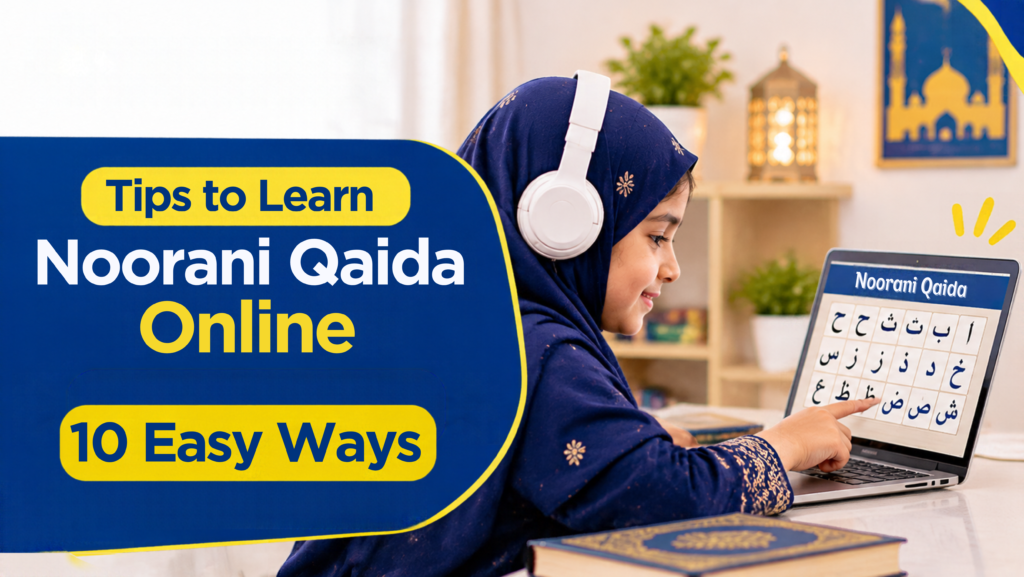
What Is Noorani Qaida?
Noorani Qaida is a beginner’s course designed to teach the basics of reading the Quran. It introduces the Arabic alphabet, the sounds each letter makes, and the core reading rules, in a carefully ordered sequence where every lesson builds on the one before.
Think of it as learning to walk before you run. Instead of opening the Quran and feeling overwhelmed, you first master letters, short sounds and simple combinations. By the time you reach the Quran itself, the script feels familiar and your pronunciation is already on solid ground.
If you’d like background on the writing system itself, you can read a short overview of the Arabic alphabet to see how its letters change shape depending on their position in a word.
What You Will Learn in Noorani Qaida
Although exact lesson order can vary between teachers, a typical Noorani Qaida course covers these building blocks:
- Arabic letters and their correct sounds
- Makharij, the articulation points where each letter is produced
- Harakat, the short vowel marks (fatha, kasra, damma)
- Tanween, the doubled vowel endings
- Long vowels (madd) and how to stretch sounds correctly
- Sukoon, shaddah and joined letters
- Basic stopping and reading rules that prepare you for Quran recitation
Once these are in place, you’re ready to move on to reading and Tajweed with confidence.
10 Tips to Learn Noorani Qaida Online
Tip 1: Start with a Live Teacher, Not Just Videos
Videos are helpful for listening, but they cannot hear you. Arabic has sounds that don’t exist in English, Urdu or many other languages, and small mistakes are easy to make without noticing. A live teacher listens to your pronunciation and corrects it on the spot, which is the fastest way to build correct habits from day one.
Tip 2: Master the Letters Before Rushing Ahead
It’s tempting to skip forward when the first lessons feel simple. Resist that urge. Every later lesson depends on your ability to recognize letters instantly and pronounce them correctly. A strong start saves weeks of re-learning later.
Tip 3: Focus on Makharij from Day One
Makharij, the exact points of articulation, are the heart of correct pronunciation. Ask your teacher to show you where each sound comes from: the throat, the tongue or the lips. Practicing in front of a mirror can help you see how your mouth moves.
Tip 4: Practice a Little Every Day
Ten to fifteen minutes of daily practice beats one long session a week. Short, frequent repetition helps letters and sounds settle into memory and builds the muscle memory your tongue needs. Consistency is the single biggest predictor of progress.
Tip 5: Learn Letter Shapes in All Positions
Arabic letters often change shape at the beginning, middle and end of a word. Spend extra time recognizing each form. A simple trick is to write the letter in all its forms on a card and review it a few times a day.
Tip 6: Read Aloud, Slowly
Silent reading doesn’t train your mouth. Read every line out loud, slowly and clearly, and only speed up when accuracy is perfect. Speed is a result of accuracy, never a substitute for it.
Tip 7: Listen to Correct Recitation Daily
Training your ear is as important as training your tongue. Listening to a clear, slow reciter helps you absorb rhythm and pronunciation. You can find many reciters on Quran.com and follow along while you practice your lessons.
Tip 8: Revise Before Starting Something New
Begin each class with a quick review of the previous lesson. Revision keeps earlier rules fresh and lets your teacher spot anything that needs more work before it turns into a habit.
Tip 9: Record Yourself and Listen Back
Recording a short recitation on your phone lets you hear your own mistakes, and you will often notice things you missed while reading. Share the recording with your teacher for focused feedback.
Tip 10: Set a Fixed Time, a Quiet Space and a Small Goal
Choose a time you can keep every day, a quiet spot with good lighting and a stable internet connection, and one small goal for each week, such as finishing a specific lesson. Clear routines remove the “should I practice today?” debate and make progress automatic.
A Simple 4-Week Starter Roadmap
Every learner moves at their own pace, but this sample plan shows how a beginner might structure the first month with a teacher’s guidance.
Week 1: Letters and sounds
Recognize the letters, practice their basic sounds and begin makharij.
Week 2: Short vowels and joined letters
Learn the harakat and practice reading simple letter combinations slowly.
Week 3: Tanween and long vowels
Add tanween and madd, and focus on holding sounds for the right length.
Week 4: Sukoon, shaddah and review
Practice sukoon and shaddah, then revise everything covered so far with full lines of reading.
A teacher will adjust this to fit your level, so treat it as a guide rather than a strict timetable.
Common Mistakes Beginners Make
- Skipping lessons to go faster: This leaves gaps that show up later in Quran reading
- Learning only from videos or apps: No one is there to correct your pronunciation
- Memorizing shapes without sounds: Recognizing a letter isn’t the same as pronouncing it correctly
- Practicing irregularly: Long breaks cause forgetting and frustration
- Being afraid of mistakes: Making mistakes out loud is how learning happens, so reciting freely matters
- Moving to Quran reading too early: A strong Qaida foundation makes Tajweed far easier
Tips for Parents of Young Learners
If your child is learning Noorani Qaida, a few small gestures make a big difference.
- Keep sessions short and positive: Fifteen to twenty focused minutes is plenty for young children
- Celebrate small wins: A new letter learned deserves real praise
- Stay nearby during online classes: This helps with focus and safety
- Avoid comparing your child to others: Every child moves at their own pace
- Choose the teacher your child feels comfortable with: Comfort helps children recite freely
A child who enjoys class will keep asking for more, and that enthusiasm is worth more than any schedule.
How Long Does It Take to Learn Noorani Qaida?
The time depends on age, how often you attend and how much you practice between classes. Many beginners complete the course within a few months when they attend regularly and practice daily, while younger children or those practicing less often may take a little longer, and that is perfectly normal. What matters most is not speed but solid understanding, because everything you learn here becomes the foundation for reading the Quran.
Start Noorani Qaida with MualimulQuran
If you want to put these tips into practice with expert guidance, our Noorani Qaida course is designed for exactly this stage. Classes are live and one-to-one, taught by qualified male and female tutors, with flexible timings that fit school, work and different time zones. The course is open to children from age 6 and adults of any level, with no prior Arabic knowledge required.
Not sure if it’s right for you? Start with a free trial class, meet your teacher and see the teaching style first-hand before you decide anything. When you’re ready to move forward, you can explore our full range of Quran courses, including the Quran Tajweed course that naturally follows Noorani Qaida.
Take the First Step Today
Every confident Quran reader began with a single letter. With the right tips, a steady routine and a patient teacher, you or your child can build a strong foundation and enjoy every step of the journey.
Ready to begin? Book a free trial class with MualimulQuran today and start learning Noorani Qaida the right way.
